Educators
Bilingual, ESL, general and special education teachers: tell language learning apart from signs of dyslexia and know your next step in the classroom.
A field manual · Now available
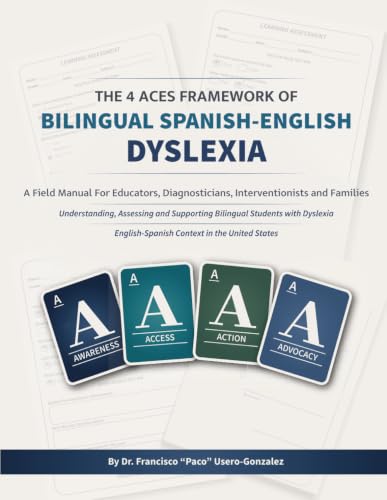
A Field Manual for Educators, Diagnosticians, Interventionists and Families
Understanding, assessing and supporting bilingual students with dyslexia in the English-Spanish context of the United States.
By Dr. Francisco “Paco” Usero-González
When a student is learning in Spanish and English, a language difference can be mistaken for dyslexia, and dyslexia can hide behind a second language. This field manual gives the adults around that student a shared framework for seeing clearly and acting on it.
See how dyslexia shows up when a student lives and learns in two languages.
Open the way to fair assessment and to instruction that counts both languages.
Turn understanding into support, at school and at home.
Stand with bilingual students with dyslexia and their families.
Everyone around a bilingual student with dyslexia has a part to play. Find yours.
Bilingual, ESL, general and special education teachers: tell language learning apart from signs of dyslexia and know your next step in the classroom.
Evaluate with both languages in view, so the results reflect the whole student and not only their English.
Read each student’s profile across both languages before a label is given, and guide the team toward the right support.
Plan support that builds on what the student already knows in Spanish and in English.
Understand what your child is experiencing and become their strongest ally at school.
Build campus and district systems where bilingual students with dyslexia are identified and served by prepared staff.
Ground your advocacy in a clear picture of dyslexia across two languages.
For material reviews, book studies, team orders or professional learning, get in touch with the author.
Contact the author